




A court hearing in Argentina leaves the fate of the Russian spiritual teacher dependent on a medical evaluation, while questions grow about the behavior of the prosecution.
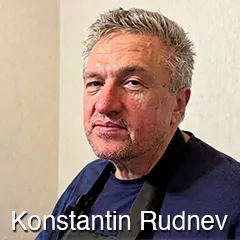
by Alessandro Amicarelli — A new hearing was held today in the long and troubled case of Konstantin Rudnev, the Russian spiritual teacher whose health has deteriorated to the point that several doctors have concluded that he cannot safely endure imprisonment. The hearing focused on the defense’s request to postpone the forensic medical examination scheduled for June 25, 2026. The outcome of this examination will determine whether Rudnev remains under house arrest or is returned to prison, a decision that carries potentially lifethreatening consequences for a man whose physical condition has been repeatedly described by specialists as fragile.
The defense insists that the medical situation is serious. Three doctors, including one appointed by the prosecution, have issued conclusions before the hearing indicating that Rudnev cannot be held in a penitentiary environment. Despite this, the prosecution continues to demand that he be transported to a medical facility for examination. The defense regards this insistence as disproportionate and harsh. They recall that Rudnev was previously denied timely medical assistance and that the current attempt to move him for the examination forcefully disregards the medical conclusions already on record. According to the defense, such behavior reveals an absence of human sensitivity among officials who hold significant power over the life of a vulnerable person.
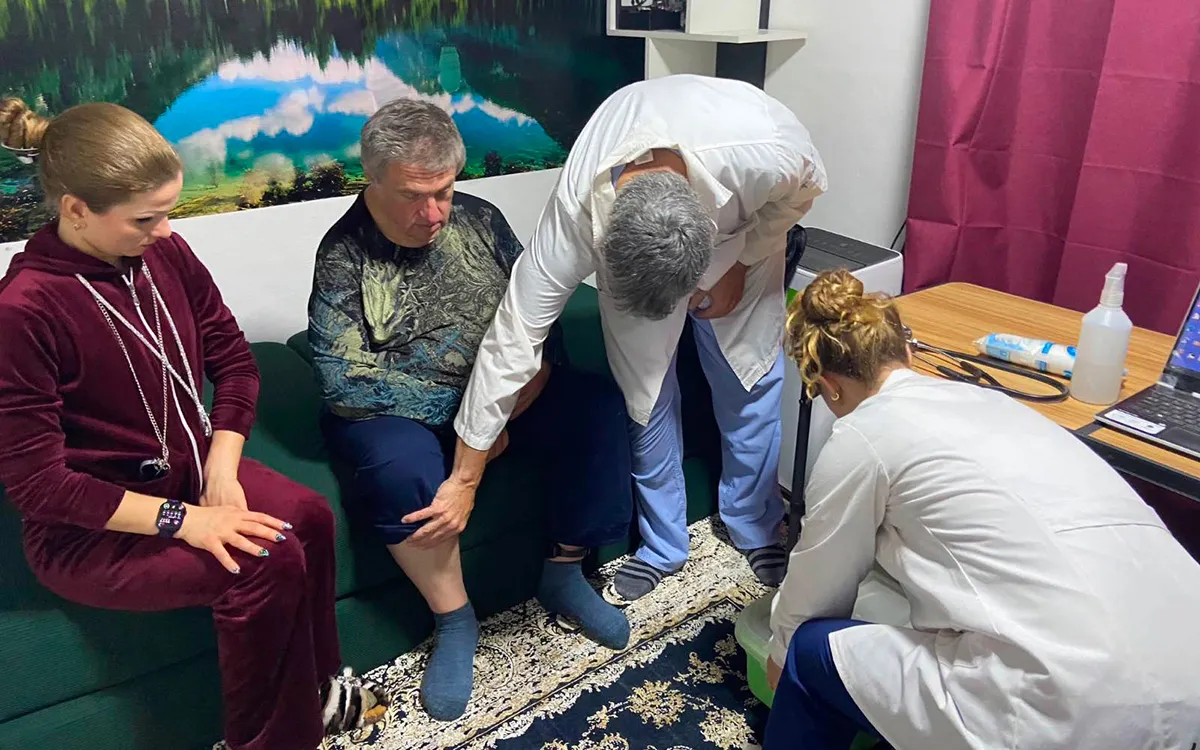
Rudnev during a recent medical examination
The defense raises questions about the motivation behind the prosecutorial stance. They suggest two possible explanations: personal animosity toward Rudnev or an external scheme. In either case, they argue that prosecutors who display such attitudes should not continue to handle the case. They emphasize that individuals entrusted with human destinies must act objectively and with respect for human dignity. Particularly troubling to the defense was the prosecution’s statement that the forensic medical examination must yield the expected result. The defense lawyer expressed astonishment at this approach, which they believe undermines the independence of the medical evaluation.
The defense also recalls the circumstances of Rudnev’s transfer from prison to house arrest. Instead of arranging safe air transportation, he was required to travel by ground across a large portion of the country. This was done despite his serious illness and a large inguinal hernia. The journey was long, uncomfortable, and physically demanding, with limited space and no opportunity to move freely or use the toilet promptly. The defense asks why such haste was necessary and why additional suffering was imposed on a person whose condition was known to all parties involved.
The attempt to return Rudnev to prison despite multiple medical conclusions is viewed by the defense as further evidence of an approach that appears punitive rather than procedural. They argue that prosecutors should maintain neutrality, especially in matters of health where they lack expertise. Their role is to ensure respect for the law and the protection of rights. The defense believes that the pattern of opposing medical treatment and measures to preserve Rudnev’s health casts doubt on the prosecution’s objectivity. The defense asks why medical specialists are ignored and why health decisions seem to be made by officials without medical expertise.
The defense also highlights the role of Federal Judge Gustavo Javier Zapata, who granted house arrest six months ago based on medical conclusions documenting severe weight loss, the consequences of a complex operation, and the need for recovery in a calm environment. They describe the judge’s decision as guided by both the law and humanity. They contrast this with the actions of the prosecutors, led by Fernando Arrigo, coordinator of the Río Negro region, and his assistants Tomás Labal and Gustavo Revora, who appealed the decision and continue to insist on imprisonment despite repeated medical warnings that such a measure would cause irreversible deterioration.
The defense notes that Rudnev has never attempted to flee, that his documents have been seized, that he wears an electronic bracelet, and that he intends to remain in Argentina to seek acquittal. They argue that the refusal of house arrest and the obstruction of medical care resemble an effort that produces harm rather than a legitimate procedural strategy. They also point to parallels with the case of Mapuche leader Facundo Jones Huala, where prolonged detention and delayed medical care produced serious health consequences. For the defense, the repetition of similar patterns in unrelated cases handled by prosecutors coordinated by Arrigo suggests a broader problem.
Particular concern is directed at a statement attributed to prosecutor Tomás Labal, who reportedly claimed he could influence the independent medical commission in Buenos Aires to examine Rudnev at home. The defense regards this as an attempt to control the medical assessment. They argue that such statements raise questions about the process’s independence and the conduct of those involved.
The defense observes that aggressive practices of this kind were not seen on this scale before Arrigo’s appointment to a key regional position. They claim that cases involving indigenous leaders intensified and that a case against Rudnev was initiated without convincing evidence. They argue that when state power is used in ways that worsen the situation of individuals and their families, those responsible lose the moral and professional right to hold their positions. They describe the current situation as a sequence of deliberate actions that harm the health and wellbeing of a person whose guilt has not been proven.
These actions will now be closely monitored by both international experts and a domestic expert commission. The defense warns that any attempt to pressure doctors or medical commissions will be documented and evaluated. They ask why Arrigo allows his subordinates to act in this manner and why he does not intervene to stop what they describe as an abuse of power.
For the defense, the case has moved beyond a discussion of preventive measures. It has become a question about the values that guide the justice system. They argue that Rudnev does not pose a danger to society and that the insistence on imprisonment appears to be connected to the interests of those who have built their careers on the case. They conclude that the situation constitutes an abuse of power concealed behind procedural language and must be addressed before it produces irreversible consequences.


