






CAP-LC (FOB partner) and United for Human Rights seek justice for the political and spiritual Russian dissident prosecuted in Argentina with dubious accusations.
by Massimo Introvigne — The case of Russian spiritual teacher Konstantin Rudnev, detained in Argentina since 2025, has taken a dramatic and deeply worrying turn. CAP-LC and United for Human Rights have now submitted a new written statement to the UN Human Rights Council, warning that the situation has “significantly worsened” since their previous filing at the Council’s last session. That earlier statement, as “Bitter Winter” reported in January, already documented the role of Russian-generated disinformation in shaping the Argentinian proceedings. The new submission makes it clear that the risks to Rudnev’s health, safety, and due process rights have now reached a critical point.
Rudnev suffers from severe pulmonary fibrosis, a condition that has deteriorated sharply during his detention. He now requires hospitalization and surgery. Three different judges ordered that he be transferred from a maximum-security prison to house arrest, yet prosecutors appealed each decision, delaying implementation for months. Even after the third order was finally executed, the pressure has not ceased. Argentina’s Court of Cassation has now accepted a prosecutorial recourse seeking to revoke house arrest and return Rudnev to jail, despite his medical fragility and the absence of evidence against him. CAP-LC and United for Human Rights warned that this prosecutorial cruelty “raises fundamental questions about the rule of law in Argentina” and places Rudnev at immediate risk.
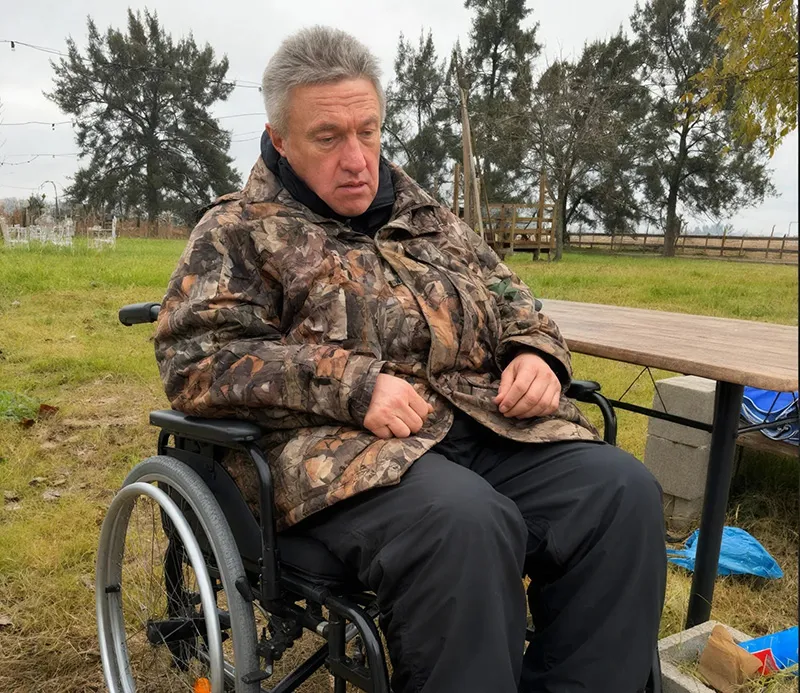
Under house arrest and in a wheelchair: Konstantin Rudnev.
Download the statement as a PDF (the Human Rights Council will assign the distribution date and number at a later stage).
The joint statement reiterates that “Rudnev remains the only defendant in his case who is still under arrest,” even though forensic examinations have disproved the original allegations and no evidence has emerged of an organized group or criminal activity. The organizations emphasize that pretrial detention must be exceptional under Article 9 of the ICCPR and cannot be used “to search for proof, exert pressure, or punish defendants.” Yet the prolonged deprivation of liberty, the denial of adequate medical care, and the repeated refusal to implement judicial orders suggest that detention has taken on a punitive character.
The filing also situates the case within a broader pattern. Argentina’s expansive definition of “trafficking” has increasingly been applied to minority religious or spiritual groups labeled as “cults,” often based on unverified allegations. Pre-trial detention, which should be the exception rather than the rule according to international law, has become routine in Argentina.
At the same time, the reputational narrative constructed in Russia—where Rudnev was targeted through media campaigns, pseudoexpertise, and fabricated accusations—has followed him across borders. Local Argentinian media reproduced Russian claims without verification, creating an atmosphere in which suspicion replaced evidence. CAP-LC and United for Human Rights note that this “reputational harm exported from Russia has influenced institutional behavior,” contributing to the severity of Rudnev’s treatment.
The organizations also highlight new concerns about transnational repression. Rumors that the Russian Federation may seek Rudnev’s extradition have intensified. Given Russia’s documented record of persecuting dissidents and subjecting detainees to inhumane treatment, any extradition request would violate the principle of nonrefoulement. The statement recalls that individuals labeled as “cult leaders” in Russia face heightened risks, including violence from other inmates and denial of medical care. The deaths of political prisoners in Russian custody underscore the gravity of these dangers.
The joint submission concludes with a series of urgent recommendations. It calls on Argentina to deny any further prosecutorial attempts to return Rudnev to prison, to review the charges in light of the absence of evidence and the indications of foreign generated disinformation, and to categorically refuse any extradition request from Russia, if any. It also urges the Human Rights Council to recognize the case as an example of how “reputational narratives constructed in one country can shape judicial outcomes in another,” undermining due process and endangering vulnerable individuals.
With Rudnev’s health now in a precarious state and the Cassation Court considering a request that could send him back to a maximum security facility, the urgency of the situation has escalated dramatically. Without immediate corrective action, Argentina risks becoming the stage for a grave miscarriage of justice—one whose origins lie not in Buenos Aires or Bariloche, but in Moscow.
Source: Bitter Winter


