






As the consequences of the 2007 Tai Ji Men ruling continue to unfold, they reveal how constitutional guarantees depend on the conduct of administrative power.
(A paper presented at the webinar “A Legal Victory, an Administrative Injustice: The 19th anniversary of Tai Ji Men Supreme Court Acquittal,” co-organized by CESNUR and Human Rights Without Frontiers on July 13, 2026.)
by Alessandro Amicarelli — Over nineteen years have passed since July 13, 2007, when Taiwan’s Supreme Court spoke with absolute clarity. On that day, Tai Ji Men was declared completely innocent of all criminal charges, including tax evasion. The Supreme Court stated once and for all that the contents of the red envelopes given by Tai Ji Men dizi (disciples) to their Shifu (Grand Master) were gifts, not taxable income, contrary to the National Taxation Bureau (NTB), which had treated them as tuition fees. The Supreme Court ruling was unambiguous, impartial, and final.
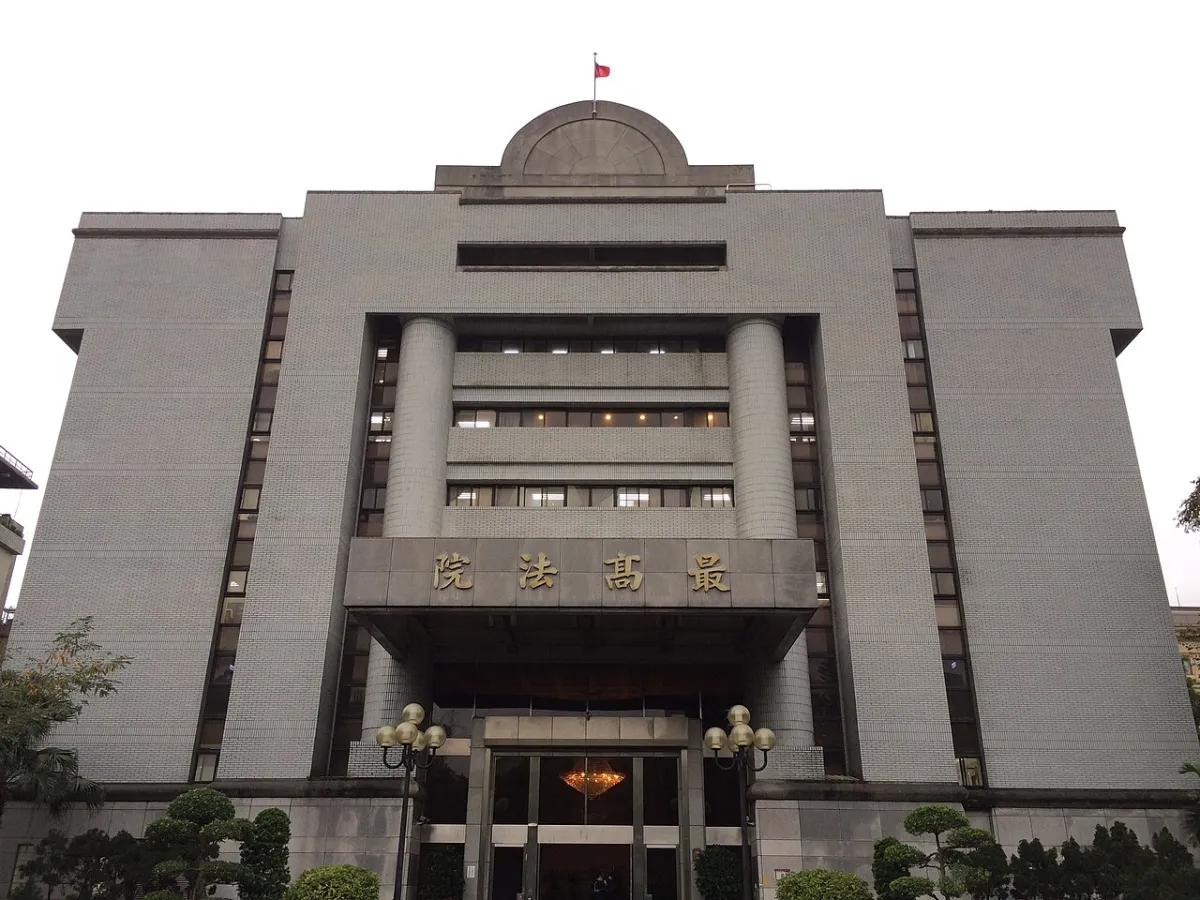
Taiwan’s Supreme Court. Credits.
Nonetheless, nineteen years later, the ruling is still only partially implemented. In fact, while the NTB corrected all the other tax bills to zero, the 1992 bill was kept based on a technicality, thereby allowing its use in 2020 to nationalize land that Tai Ji Men regards as sacred. This is not a mere administrative mistake or an oversight. This is sheer state abuse and a constitutional failure. It demands accountability from those responsible for the failure.
In any modern democracy based on the primacy of law, a Supreme Court is not just one institution among many. It is the guarantor of the constitutional order, and its rulings are binding on and guide all governmental bodies, agencies, and officials without exception. When an administrative body refuses or does not implement a judgment of the Supreme Court, it commits a serious violation of various principles and provisions, undermining judicial authority, and, by these acts, the rule of law is eroded and vanishes.
This is precisely why we have repeatedly emphasized that the Tai Ji Men case is not only about Tai Ji Men. It is about the integrity of Taiwan’s legal and constitutional system as a whole and a test of its maturity. The refusal, whether willful or de facto, to enforce the Supreme Court’s final ruling is a direct breach of Articles 7, 16, and 23 of Taiwan’s Constitution that guarantee Equality, the Right to Legal Remedies, and Proportionality in state action. It likewise violates the Administrative Procedure Act, the Tax Collection Act, and the fundamental principle that court rulings must be enforced rather than interpreted. When this principle is violated, the constitutional order is weakened.
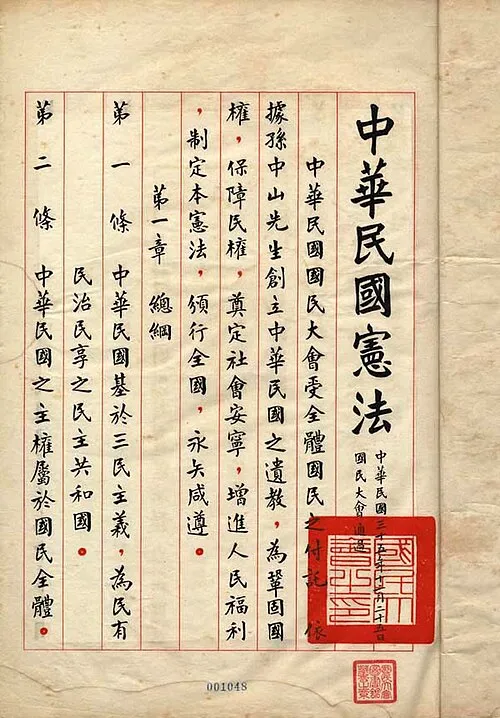
First page of the Nanking Constitution of the Republic of China of 1946, which remains in force in Taiwan. Credits.
As Massimo Introvigne said in his introduction to this webinar: “Administrative agencies refused to internalize the judicial findings (…) Bureaucrats continued to behave as if the courts had never ruled.” This is not unique to Taiwan, as evidenced by the Yenish case in Switzerland, which shows how bureaucracies can resist court rulings for decades, even in mature democracies. This Taiwan-Switzerland parallel illuminates the bureaucrats’ pattern of resistance that causes victims to suffer, institutions to lose their legitimacy, and justice to be delayed for generations. Tai Ji Men families have suffered this ordeal for thirty years since the beginning of the unlawful persecution by the public prosecutor and nineteen years since the final ruling of the Supreme Court.
After all these years, it is time to affirm accountability. Accountability is not revenge. It is the only legal way in democracies to prosecute those who made mistakes or willingly abused the law; in other words, it is the only way to maintain or restore the primacy of law when necessary, and to enable the nation to resist its own institutional failure. Those who refused to enforce the Supreme Court ruling, just as those who built up a judicial case based on intentionally false or non‑existent evidence, must be held accountable for the violation of the Taiwanese Constitution, which requires administrative agencies to obey judicial decisions; of the principle of legality, as they acted without lawful basis at least after 2007; of fundamental human rights such as freedom of religion or belief, property rights, and the right to fair administrative treatment; and of public trust in the state institutions, damaging Taiwan’s international reputation as a beacon of democracy in Asia committed to rule of law.
Accountability for those who failed in the Tai Ji Men case is necessary not only for justice to Tai Ji Men itself, which certainly needs to be affirmed, but to ensure that in the future no individual, family, or group, whether religious, cultural, or otherwise, faces any similar abuses at the hands of public officials.
As my colleague Francesco Curto, speaking today before me, just said: “Justice does not end with a court paper. It ends when that paper becomes real.” Despite Tai Ji Men showing an incredible degree of patience and respect for the nation and its institutions, dignity and perseverance waiting for justice to be fulfilled, nineteen years later, that paper is still just a statement waiting to become reality.
The struggle of Tai Ji Men has contributed to national progress and to the affirmation of Taiwan as a mature democracy. It is now time for Taiwan to complete the work that began on July 13, 2007. The time for accountability for those who abused the law, and for justice to be enforced, is today.

Tax and Legal Reform League protests in Taiwan.
Today’s anniversary should resound not only as a commemoration but rather as a warning. Bureaucrats are not in charge of reinterpreting final judgments or selecting the parts of the final ruling they like while ignoring the rest as they please. Constitutional rights do not depend on the discretion of tax officials or other bureaucrats; rather, they are a test to be applied whenever the law is implemented. When public bodies’ actions violate a constitutional principle, those actions are unlawful and illegitimate, no matter who implemented them. The constitutional principles serve as a test that should guide all actions taken by public officials.
We all agree that over the years, Taiwan has made important progress in human rights and democratic values. In this regard, the adoption of the United Nations human rights covenants into national legislation, despite Taiwan’s non-membership in the UN, is a clear example of commitment to change. Despite these changes and positive progress, however, the Tai Ji Men case reveals a structural weakness that must be addressed.
In compliance with Article 24 of the Taiwanese Constitution, accountability is the only way forward to affirm justice for Tai Ji Men and to create a general pattern for the future. Article 24 of the Constitution of Taiwan reads: “Any public functionary who, in violation of law, infringes upon the freedom or right of any person shall, in addition to being subject to disciplinary measures in accordance with law, be held responsible under criminal and civil laws. The injured person may, in accordance with the law, claim compensation from the State for damage sustained.”
This will require, for instance, a full investigation to find out who caused the 2007 ruling not to be implemented, to take disciplinary or legal actions to prosecute the officials who acted outside the law, to adopt legislative reforms ensuring that administrative bodies must follow and implement judicial decisions, and to provide restoration of all confiscated property and full redress for all damages suffered. This will mean finally declaring justice for Tai Ji Men and affirming and restoring Taiwan’s constitutional order.
Published also on Bitter Winter


