




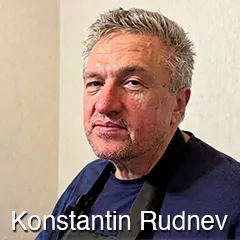
How recycled Russian propaganda and misreported events in Montenegro created a false scandal around a dissident seeking refuge.
by Alessandro Amicarelli — When Konstantin Rudnev arrived in Montenegro in February 2022, he did so as a man seeking protection rather than visibility. He had spent eleven years in Russian prisons, eight of them in solitary confinement. Russian authorities had repeatedly targeted him since the 1990s for his religious activities and his criticism of the government. After the war in Ukraine began, remaining in Russia was not an option. Montenegro, which had become a refuge for many Russians opposed to the war, including some of Rudnev’s wife’s friends, offered a legal path to international protection. Rudnev applied for asylum, obtained residence permits, and settled quietly in the coastal city of Bar. His life there was uneventful. Yet, within two years, Montenegrin and regional media would publish articles linking him to an incident in Žabljak with which he had no connection. The story of how this happened illustrates how rumors, recycled propaganda, and transnational repression can create a false narrative where none exists.
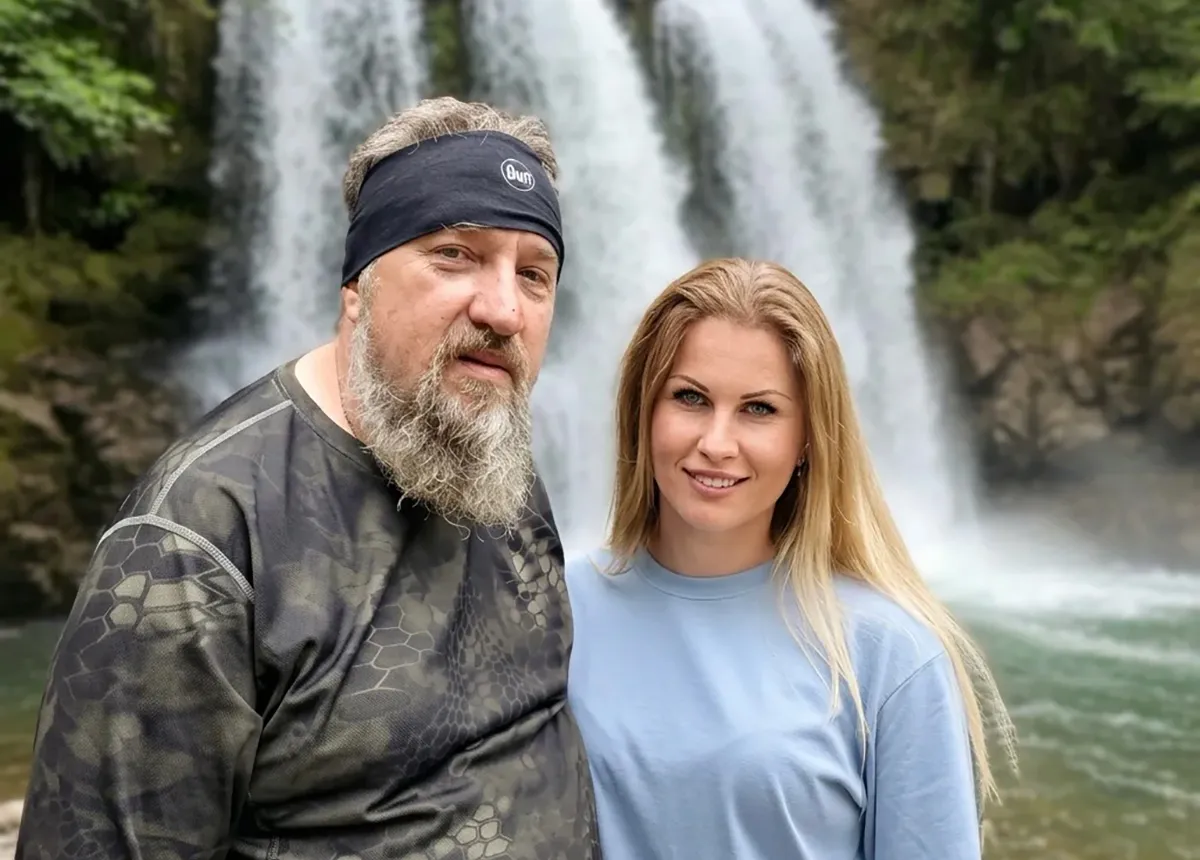
Konstantin Rudnev and his wife in Montenegro
Why this story matters beyond Montenegro
The case of Konstantin Rudnev in Montenegro is not an ephemeral local administrative episode or a simple media misunderstanding. It is part of a wider pattern increasingly observed across Europe, including the shift toward biased narratives, the vulnerability of small countries to external propaganda, and the ease with which misinformation can shape public perception and opinion. As dissidents fled Russia after the beginning of the ongoing war, host countries faced the challenge of distinguishing between legitimate asylum claims and politically motivated accusations. Rudnev’s own experience illustrates how delicate and frail this process can be when foreign propaganda is allowed to enter and influence domestic institutions. Montenegro, once an illustrious Principality steadfast in its pride and autonomy, now navigating its path between deeper Western integration and longstanding cultural ties with Russia, has become a microcosm of the tensions. This case therefore offers insight not only into Rudnev’s struggle for protection but also into the broader dynamics of transnational restraint, media manipulation, and the “weaponization” of reputation.
Arrival in Montenegro and the asylum application (2022–2023)
Rudnev entered Montenegro on February 12, 2022, through Podgorica Airport. On April 12, 2022, he submitted an application for international protection. The application detailed the reasons for his fear of returning to Russia: religious persecution, political repression, repeated arrests, the 2010 fabricated conviction that led to eleven years in prison, continuing threats after his release, and the general danger posed by the war and the Russian prison system.
The Montenegrin authorities rejected the application under Article 3 of the Law on International and Temporary Protection of Foreigners. On January 24, 2023, his lawyer filed an appeal with the Administrative Court. On November 11, 2024, the court rejected the appeal, concluding that the risk of persecution had not been sufficiently demonstrated.
The decision did not allege any wrongdoing by Rudnev in Montenegro. It simply reflected the restrictive approach Montenegro had begun to adopt toward Russian asylum seekers.
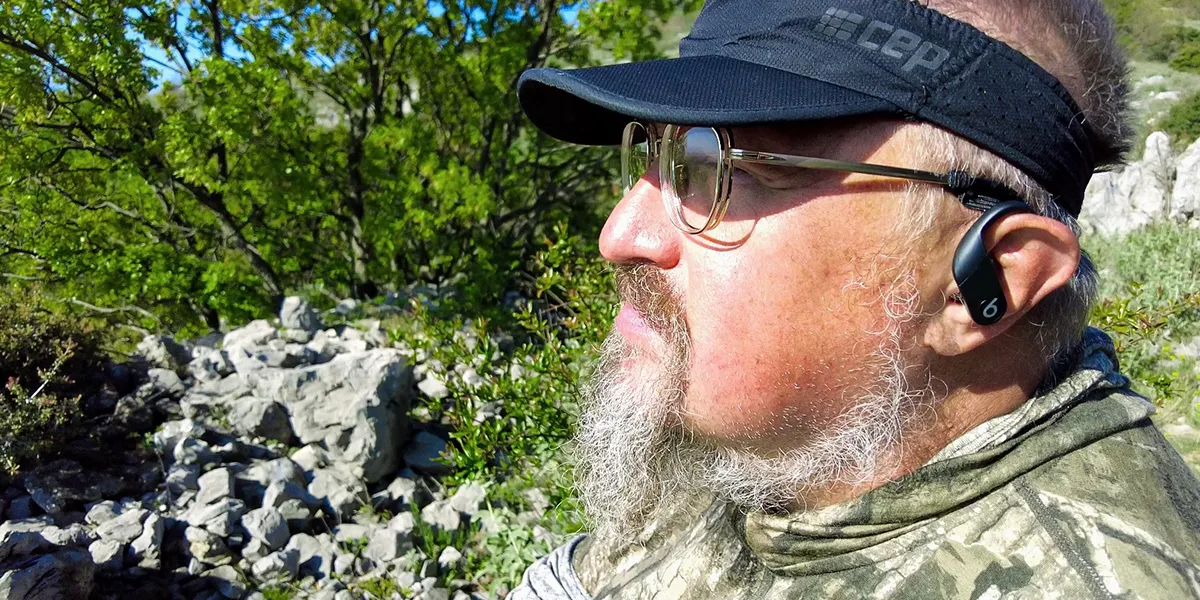
Rudnev in Montenegro in 2023
Surveillance triggered by the asylum application
Once Rudnev applied for asylum, his name became available to Montenegrin law enforcement and intelligence services. The authorities relied almost entirely on Russian materials to assess him. These materials consisted of more than twenty years of Russian propaganda portraying Rudnev as the leader of a “totalitarian cult,” a “criminal,” and a “dangerous manipulator.” No Montenegrin agency conducted an independent investigation. No expert examined his teachings. No academic or legal analysis was performed. The authorities adopted the Russian narrative.
As a result, Rudnev came under surveillance. He did not hide. He lived openly, spent time in nature, and tried to recover his health after years of imprisonment. Yet police officers repeatedly checked his documents, searched his car, and inspected the people accompanying him. These checks produced nothing. No weapons were found. No prohibited items were discovered. The searches revealed only tourist equipment and clothing.
The Anti-Putin Conference in Bar (April 2024)
In April 2024, Montenegro hosted an anti-Putin conference attended by Russian dissidents, activists, and exiles of different political persuasions. Montenegro had become a gathering point for Russians who opposed the war and the Kremlin.
Some media covered the conference and described how Russian opposition figures were gathering to discuss the war, repression, and the future of Russia. They also noted that Montenegro had become a hub for political refugees. The conference brought together individuals who had publicly opposed the Kremlin. Given the relationships between Montenegro and Russia, it was unsurprising that Montenegrin security services took an interest in the participants.
Rudnev was invited to attend the congress. He and his wife stayed in a hotel in Bar. During the event, police and migration officers conducted a routine document check of all hotel guests. Their passports and residence permits were verified. No violations were found. Several people, including Rudnev, were questioned. Some documents, electronic equipment, and a home first aid kit were temporarily seized. Since no offenses were identified, everyone was released immediately.
It was a standard procedure for all conference participants. It did not involve any suspicion of wrongdoing. It did not lead to any administrative or criminal proceedings. It ended the same day.
Reportedly, an American woman staying at the hotel was found in possession of a large quantity of pharmaceutical products, and an investigation was opened for possible unauthorized trade (article 284 of the Criminal Code of Montenegro). It appears that no charges were filed. However, other hotel guests were interrogated about possible connections to the woman.
When Rudnev was arrested in Argentina, a request was sent to Montenegro regarding possible illegal activities he had been involved in there. On April 16, 2025, Interpol’s National Central Bureau for Montenegro in Podgorica responded by email that “A local warrant was issued for the person Rudnev KONSTANTIN by the Local police unit in Bar—the economic crime suppression unit, to collect additional information (to take a statement) from him as a citizen for the criminal offense of illicit trade from Article 284 of the Criminal Code of Montenegro.”
Rudnev and his wife claim they never received a summons to testify in the Article 284 case, possibly because they had changed their residence or because the summons was issued after they had left Montenegro. Prosecutors in Argentina used the April 16, 2025, email as evidence that Rudnev had committed crimes in Montenegro. In fact, the local police hoped to “collect additional information” by “taking a statement” from him.
Unpleasant as it was, the incident at the Bar hotel did not result in any administrative or criminal proceedings against Rudnev. However, media campaigns largely based on Russian sources and claiming that he was reorganizing his “cult” in Bar influenced Rudnev’s decision to move to a more secluded area in Northern Montenegro. There, police surveillance continued, but no evidence of wrongdoing was found, and no charges were filed.
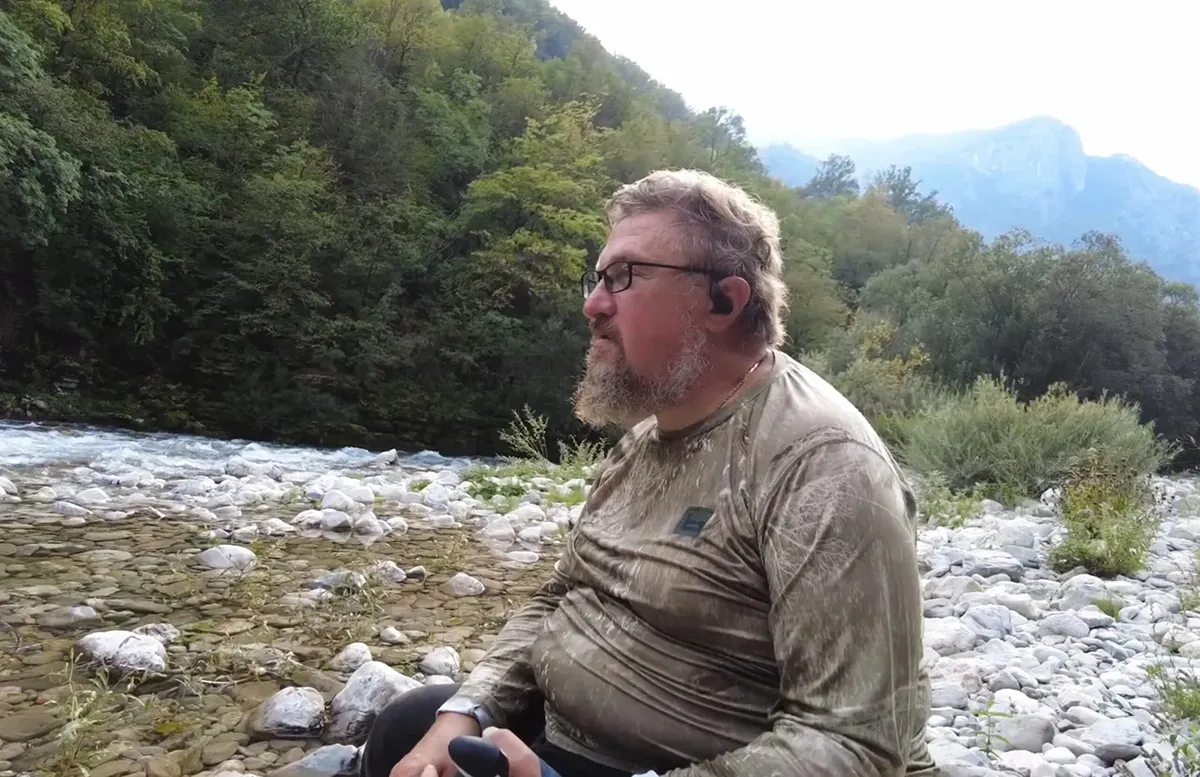
Rudnev in Montenegro in 2024
Montenegro’s political climate and Russian influence
To understand why the April document check later became the seed of a media scandal, one must consider Montenegro’s political climate. Although Montenegro is formally aligned with Western institutions, Russian influence remains strong in parts of society and media. Russian citizens have long invested in Montenegro’s tourism and real estate sectors. Russian media narratives circulate widely. Russian intelligence networks have historically operated in the region. In this environment, Russian propaganda about dissidents can easily be reproduced by local outlets without verification. Some vocal opponents of Putin have been arrested under various pretexts.
The anti-Putin congress may have triggered heightened surveillance. Rudnev’s name, already associated with Russian propaganda, appeared in the context of opposition activity. This combination made him a target for increased scrutiny. The April document check was routine, yet it placed him on the radar of journalists who later sought to connect him to unrelated events.
A completely separate incident: Žabljak (October 2024)
Six months later, in October 2024, a completely different incident occurred in a completely different part of Montenegro. In the mountain town of Žabljak, police detained several Russian tourists staying in a rented house. The police raided the house, and several women were detained.
The coverage of the arrests by the pro-Russian daily “Pobjeda” set the tone. Several other media in Montenegro, Serbia, and Russia repeated the information. On October 7 and again on October 8, “Pobjeda” reported that the police had confiscated the passports of several Russian women and that the rented facility was suspected of being used for online filming of adult films. The article claimed that local citizens “heard unusual sounds coming from the rented building, which raised suspicions that something strange was happening.” “The raid revealed that the rented facility was suspected of being used for online filming of adult films,” “Pobjeda” said.
The article went on to claim that the detained Russian citizens were “suspected of being members of the infamous Russian cult Ashram Shambhala” and that the adult film project “was organized and financed by Konstantin Rudnev, the founder of the cult.”
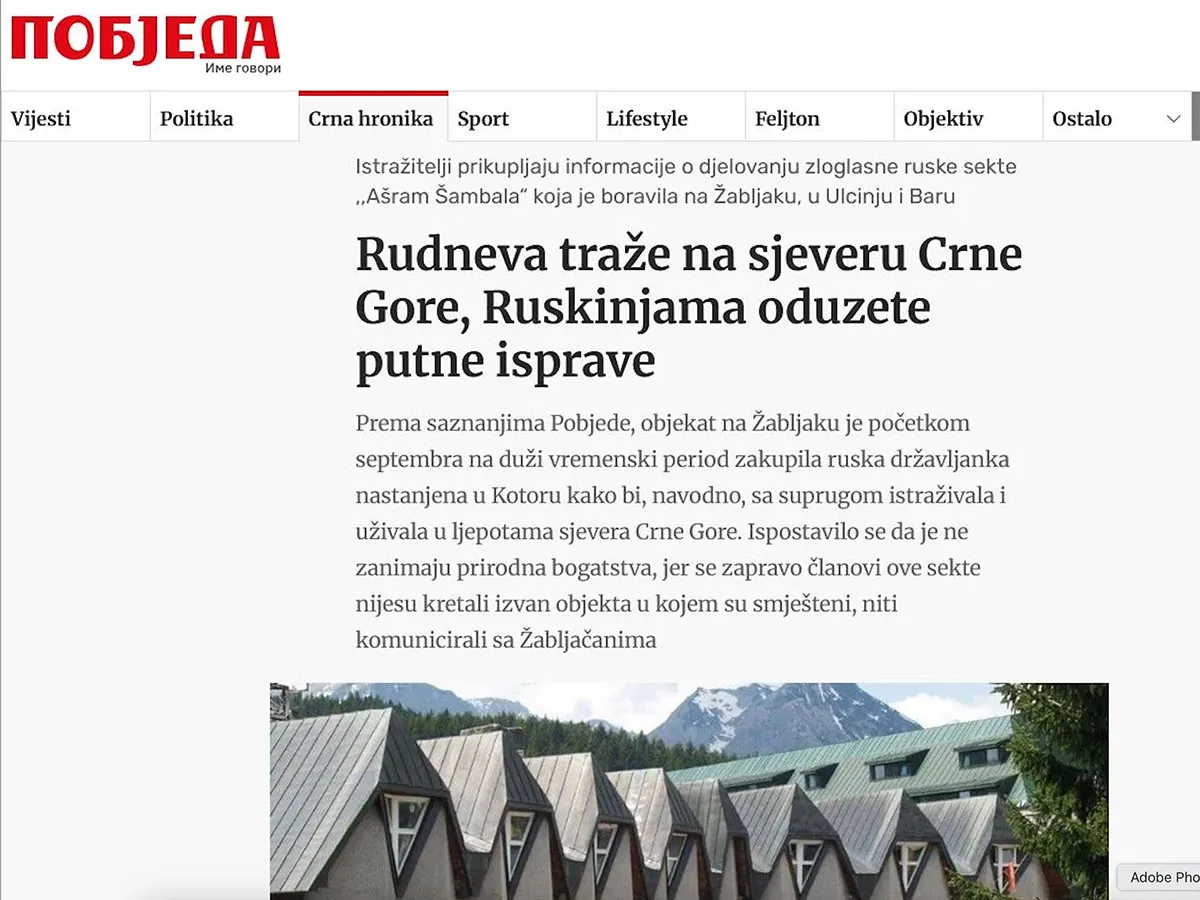
“Pobjeda” incorrectly claiming that Rudnev was “wanted” by the Montenegrin police
But in fact the role of “Pobjeda” went beyond journalism. The October 8 article boasted that it was the pro-Russian media outlet that obtained Russian documents about Rudnev and that it had asked the Montenegrin police to intervene. “Pobjeda” claimed that Rudnev was organizing in Montenegro “orgies under the guise of alleged yoga courses and sexual liberation seminars.” “More than five months ago, ‘Pobjeda’ asked the Police Directorate whether, based on reports from citizens of Žabljak and Bar, it had searched two hotels in which it found several Russian citizens,” which the newspaper insisted were members of the “cult.” “The police did not answer us,” the newspaper reported, “whether it had been determined who financed their stay, whether they were legally staying in our country, with what motive, and whether it had been determined that it was an organization and which one.”
It thus seems that Russian sources fed information to “Pobjeda,” which in turn put pressure on the police to investigate the connections between the Russians renting a building in Žabljak and Rudnev. But these connections were not found.
The Žabljak case concerned a group of Russian tourists whose identities were not disclosed. The police operation was limited to the individuals found in the house. The investigation focused on whether the women had violated Montenegrin laws on pornography. The women were questioned and released. No charges were filed. No criminal case was opened.
Rudnev did not appear as a suspect. He did not appear as the accused. His name was mentioned only in a section containing “additional information,” without any procedural relevance. If there had been real evidence of his involvement, a criminal case would have been opened. No such case exists. There is no criminal prosecution in Montenegro. There is no international wanted notice. There is no Interpol request.
Two years have passed since the first publications appeared. If the accusations had any basis, the investigation would have continued, charges would have been filed, and official documents would have emerged. None of this has occurred.
But despite the lack of evidence, several regional outlets—in Montenegro, Serbia and Russia—continued publishing articles attempting to link the Žabljak incident to Rudnev. These publications did not cite official documents. They did not explain how the connection was established. Some asserted that “Rudnev and his wife” had been detained in Montenegro, a false claim.
What happened was that some journalists, either receiving instructions from Russia or seeking a more prominent headline, had inserted Rudnev’s name into the story. They did so without verifying whether he had been present in Žabljak, had been detained, or was connected to the individuals involved. The result was a false narrative that conflated two unrelated events: the document check in Bar in April 2024 and the police operation in Žabljak in October 2024.
The timeline alone disproves the connection. Six months separated the two incidents. They occurred in different cities. Rudnev and his wife were officially registered in Bar throughout 2024. They did not travel to Žabljak. They did not know the individuals detained there. They did not participate in any events held in the house. They did not appear in any of the photographs published by the media. No man in these pictures could be mistaken for Rudnev.
Pornography allegations were based on stereotypes. In Russia, during earlier raids on buildings associated with Rudnev, investigators applied a simplistic template: if many women were present, the situation must involve prostitution or pornography. This template was used repeatedly in Russian media campaigns against him. It appears that some journalists in Montenegro or Serbia transferred these old allegations into the new context, assuming that any group of Russian women must be connected to Rudnev and that any cameras must indicate pornography.
Although not related to Rudnev, it appears that the Russians investigated in Žabljak had not committed any crime either. The official case materials in Montenegro confirm that no pornographic materials were found. The presence of cameras does not constitute proof of criminal activity. No images of erotic content were published. No charges were filed. The investigation ended without any criminal proceedings. If the police had found actual evidence of pornography, a criminal case would have been opened. This did not happen.
However, the intensification of the media campaign against Rudnev after the Žabljak incident ultimately persuaded him that he could not live peacefully in Montenegro. He then left the country and moved to Argentina.
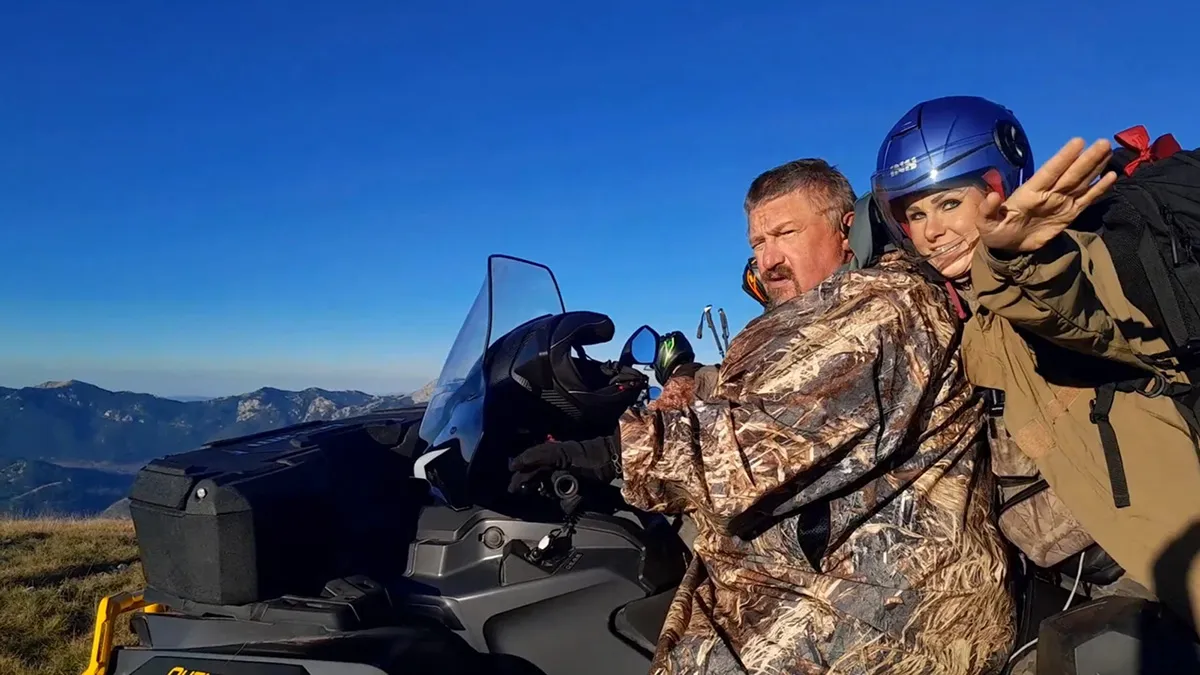
Rudnev exploring Montenegro with his wife
Montenegro media parroting Russian propaganda
Montenegrin media relied heavily on Russian sources when reporting on Rudnev. The Pobjeda articles cited above repeated claims that had appeared years earlier in Russian tabloids. They described “a Russian cult filming adult movies” and “enslaving and raping women.” These claims were not supported by evidence. They were based on recycled narratives from Russian propaganda campaigns targeting Rudnev since the 1990s.
This phenomenon is not unique. Scholars of transnational repression have documented how authoritarian states export defamatory narratives about dissidents to foreign media. Montenegro, which has historically been under strong Russian influence, is particularly vulnerable to such narratives. The Žabljak case shows how easily Russian propaganda can be reproduced in local media without verification.
Possibly, the anti-Putin congress in Bar triggered the entire chain of events. When Rudnev attended the congress, his name appeared in the context of Russian opposition activity. This likely increased the interest of Montenegrin security services, which were already relying on Russian materials to assess him. The surveillance that followed, the repeated document checks, and the eagerness of some journalists to link him to the Žabljak case all fit the pattern of transnational repression: the use of foreign institutions to extend the reach of an authoritarian state’s campaigns against dissidents.
Montenegro’s rejection of his asylum application also fits this pattern. The decision relied heavily on Russian narratives and ignored the documented history of persecution. It reflected a broader trend in which states under Russian influence adopt Moscow’s view of dissidents rather than conducting independent assessments.
The broader implications of the case
The Rudnev case highlights several structural issues:
- The fragility of asylum systems when evidence includes or consists only or mostly of foreign propaganda materials.
- The vulnerability of small countries to external influence, especially when media ecosystems lack vigorous fact‑checking mechanisms.
- The ease with which reputational harm can be exported, creating long‑lasting consequences for individuals who have already suffered prejudice and persecution in their own countries.
- The responsibility of host countries to conduct independent assessments rather than relying on politically motivated materials provided by countries of origin.
- The need for additional ethical and legal training for journalists, especially in regions where external influence is more present.
These considerations stem from the fact that the Rudnev case is not an isolated anomaly within the asylum context, but rather part of a larger pattern affecting many dissidents across Europe.
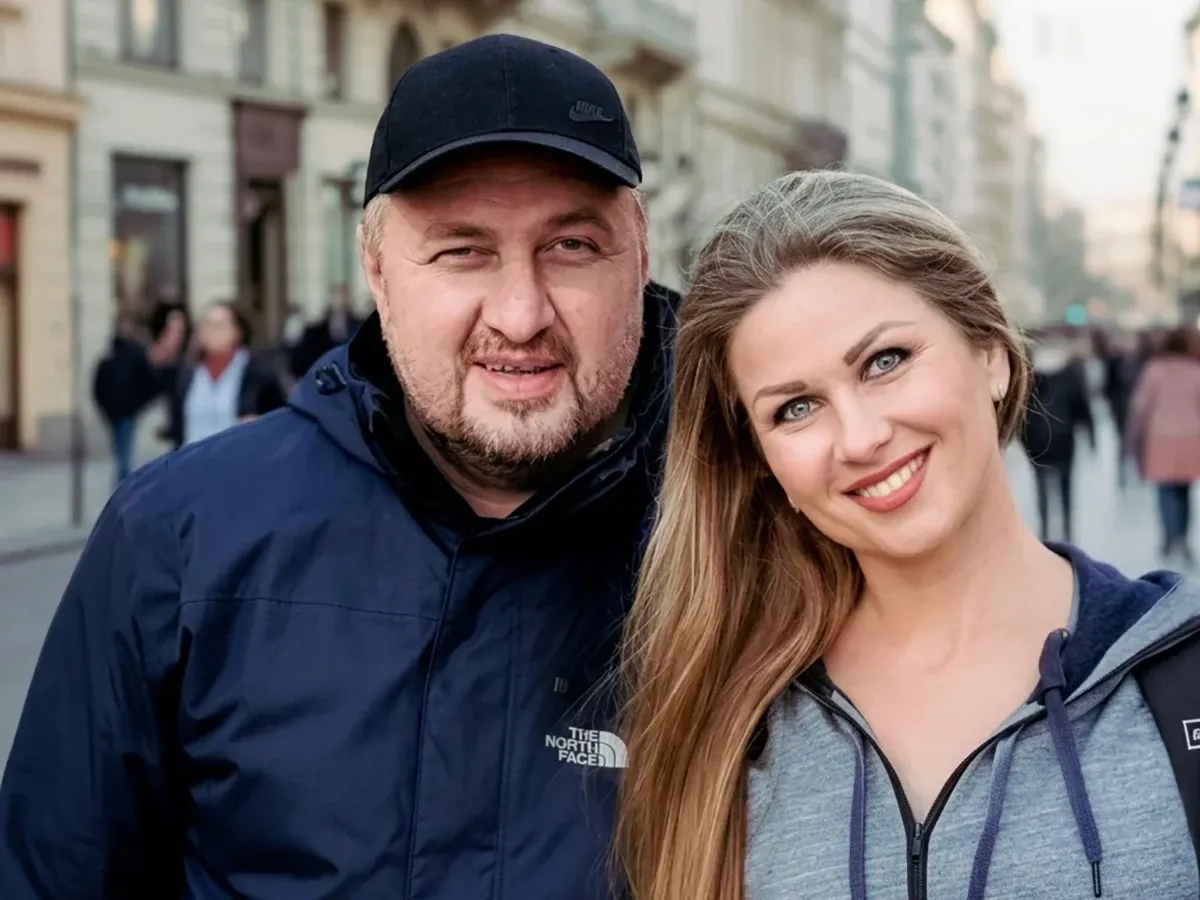
Rudnev and his wife in Moscow, shortly before they left for Montenegro
Conclusion: a manufactured scandal
The period in Montenegro of Rudnev’s life was not marked by criminal activity. It was marked by legal residence, administrative compliance, and an attempt to rebuild life after leaving Russia. The false narrative that emerged in the media reflects not his actions but the persistence of earlier campaigns against him. It shows how easily a name can be inserted into a story to make it more dramatic. It shows how difficult it is to correct misinformation once it has been published.
Understanding the Montenegro period requires separating fact from rumor. It requires recognizing that the media merged two unrelated incidents. It requires acknowledging that the connection was invented. It requires examining official documents rather than relying on speculation. It requires seeing the pattern in which Rudnev’s name is used to sensationalize stories involving Russians abroad.
The facts tell a different story: one of misrepresentation and of the media connecting events without evidence. They also tell a story of how the truth can be restored through careful examination.
Only by doing so can one understand what truly happened in Montenegro.
Published also on Bitter Winter


