




by Alessandro Amicarelli — A forthcoming collection of studies devoted to the long and troubled vicissitudes of Konstantin Rudnev and the movement known (rightly or wrongly) as “Ashram Shambhala” represents a moment of uncommon clarity in a field where confusion has too often prevailed. Anticipated by earlier treatments in “Bitter Winter,” the work of an international commission of ten scholars will appear in late August in an annotated edition published by “The Journal of CESNUR” with an introduction by University of Nevada Professor James T. Richardson, perhaps the world’s leading authority on the relations between new religious movements and the law.
It gathers contributions from scholars, legal experts, and journalists who have examined the case from different angles, each bringing forward elements that have remained obscured in public debate. I contributed an article to this collection, focusing on the period Rudnev spent in Montenegro, where I observed how narratives imported from abroad were allowed to shape perceptions and institutional reactions in ways that were neither justified nor proportionate.
The materials assembled in the volume show how the story of Rudnev has unfolded across several jurisdictions, each with its own political climate, legal culture, and vulnerabilities. What emerges is not a simple sequence of events but a chain of misunderstandings, misrepresentations, and procedural distortions that gradually accumulated until they produced consequences far removed from the facts that originally triggered official attention. The case has moved from Russia to Montenegro and then to Argentina, and at each stage the same pattern has repeated itself: allegations circulated without verification, media reports amplified untested claims, and authorities relied on information whose reliability was never seriously assessed. The result has been a progressive erosion of Rudnev’s ability to defend himself, culminating in the present situation in Argentina, where his health and safety are now matters of urgent concern.

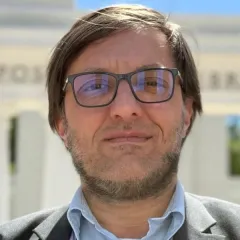
Konstantin Rudnev
My own analysis of the Montenegrin phase shows how fragile the asylum process can become when external pressures intersect with domestic uncertainties. Rudnev arrived in Montenegro seeking protection after years of difficulties in Russia. Instead of receiving a fair evaluation of his situation, he found himself confronted with a narrative already shaped elsewhere and imported wholesale into local discourse. Reports from Russia were treated as authoritative even when they lacked corroboration. Media outlets repeated sensational claims that had no basis in Montenegrin reality. The public was encouraged to believe that Rudnev represented a danger, although no criminal proceedings were ever initiated against him in the country. The entire episode illustrates how easily an asylum system can be destabilized when it becomes permeable to foreign influence and when the presumption of innocence is replaced by the presumption of guilt.
The broader collection confirms that similar mechanisms operated in Russia—as evidenced by the studies of Paris lawyer Patricia Duval and Belgian human rights activist Willy Fautré—and in Argentina, discussed by legal anthropologist María Vardé, though with different institutional actors and different political contexts. In Russia, the prosecution relied on concepts that have long been discredited in academic literature, yet they were presented as unquestionable truths. In Argentina, a minor incident was transformed into a narrative of transnational criminality, supported by documents and testimonies that did not withstand serious scrutiny. In both cases, the absence of independent expertise allowed preconceived ideas to dominate proceedings. The consequences have been severe, not only for Rudnev but also for those who sought meaning in his teachings and found themselves suddenly portrayed as victims of manipulation rather than individuals exercising personal agency.
The collection also highlights the role played by media systems that, instead of investigating, reproduced pre‑existing narratives. This dynamic has been visible in all three countries involved. Lithuanian former diplomat and author Rosita Šorytė studied the Russian media, I mentioned the role played by media hostility in Montenegro, and investigative journalist Marco Respinti examined how easily his colleagues in the West reproduced Russian propaganda. Once a particular image of Rudnev gained traction, it became nearly impossible to counter it with factual information. The public was exposed to a continuous flow of stories that reinforced one another, creating an atmosphere in which doubts were treated as complicity and nuance as evasion. The legal process was not immune to this climate, and the boundaries between journalism, activism, and institutional decision‑making became blurred.
The essays gathered in the collection do not attempt to construct an alternative mythology around Rudnev, although three of the world’s leading scholars of esoteric spirituality—Italian sociologist Massimo Introvigne, Hungarian new religious movements specialist Márk Nemes, and Polish academic specialized in esotericism Karolina Maria Kotkowska—offer a glimpse into the mythology created “by” Rudnev, and Canadian social scientist Susan Palmer analyzes how it motivated a generation of “mentors” and students.
The purpose of the articles is different: they seek to restore the conditions under which a fair assessment can take place. They examine documents, testimonies, and procedural histories with the patience required to disentangle what actually happened from what was merely asserted. They show how the case has been shaped by forces that extend far beyond the individuals directly involved. They also demonstrate that the protection of freedom of belief requires constant vigilance, especially when public opinion is mobilized against minority spiritualities.
In light of the new research, it becomes essential to address directly the version of the Argentinian prosecutors portraying Konstantin Rudnev as the leader of an organized criminal group allegedly linked to human trafficking. This narrative, repeated for years, has not been confirmed by independent inquiry. On the contrary, the examination of his biography, the available documentation, and the circumstances of the events expose the very foundation of this version as false. What emerges from the multidisciplinary work of the “commission” is not a reinterpretation of isolated details but a coherent set of conclusions reached through independent analysis, conducted outside the framework of the Argentine criminal proceedings and free from the assumptions that shaped the initial accusations.
This independence is crucial. The research was carried out by scholars, lawyers, journalists, and sociologists who examined a substantial body of materials and the broader context in which the case developed. Their findings do not merely challenge the prosecution’s hypothesis; they demonstrate that the hypothesis lacks the evidentiary support required to justify continued restrictions on liberty. In this context, the situation where the prosecutors want to send Rudnev back to jail and deny house arrest deserves particular attention. Given Rudnev’s serious health problems, any further tightening of detention conditions requires exceptionally strong justification. If the charges underlying the prosecution are not supported by sufficient evidence, a legitimate question arises as to the proportionality and necessity of maintaining such restrictions.
The principal conclusion follows naturally: if independent research does not confirm the key assumptions of the prosecution, those assumptions should no longer be used as the factual basis for further persecution. The persistence of a hypothesis after its factual foundation has been called into question raises a broader issue about the integrity of legal processes. The work of the “commission” points precisely to this problem: what happens when an initial prosecutorial narrative continues to operate even after independent inquiry has demonstrated that it cannot be sustained.
As the annotated edition of the collection is prepared for publication in “The Journal of CESNUR,” it is hoped that readers will approach the Rudnev case not through the initial labels and assumptions but through verifiable facts, independent research, and the fundamental principles of law. The essays show that the persecution of minority spiritualities rarely begins with overt hostility. It often begins with small distortions, repeated until they acquire the appearance of truth. Once that process is underway, reversing it becomes extremely difficult. The Rudnev saga demonstrates how essential it is to maintain procedural integrity, resist external pressures, and ensure that legal systems remain committed to fairness even when a public opinion manipulated by the media demands swift and punitive action.
The volume anticipated by “Bitter Winter” is therefore more than a collection of studies. It is a reminder that justice requires careful attention to detail, respect for evidence, and awareness of the ways in which narratives can be manipulated. It is also a call for renewed commitment to the principles that protect individuals who choose paths of spiritual exploration that differ from the mainstream. It asks Argentinian prosecutors, judges, and media to treat Rudnev with fairness and respect, taking into account also his serious health issues. And it invites a final reflection: when independent research undermines the factual basis of a prosecution, the only lawful and proportionate response is to bring that prosecution to an end.


