




A human rights lawyer reads CAP-LC’s Warsaw statement in light of fair-trial guarantees, international covenants and the duty to verify evidence sourced from abroad.
by Alessandro Amicarelli — Lawyers who handle cases with a foreign dimension know a recurring problem. A dossier arrives from another country, carries the authority of an official or media source, and is seldom tested with the rigor applied to domestic evidence. The written statement submitted by CAP Liberté de Conscience (CAP-LC) at the 2026 Warsaw Human Dimension Conference, organized by the OSCE Office for Democratic Institutions and Human Rights (ODIHR), describes this problem through the case of Konstantin Rudnev. It deserves as much attention from practitioners as from diplomats.
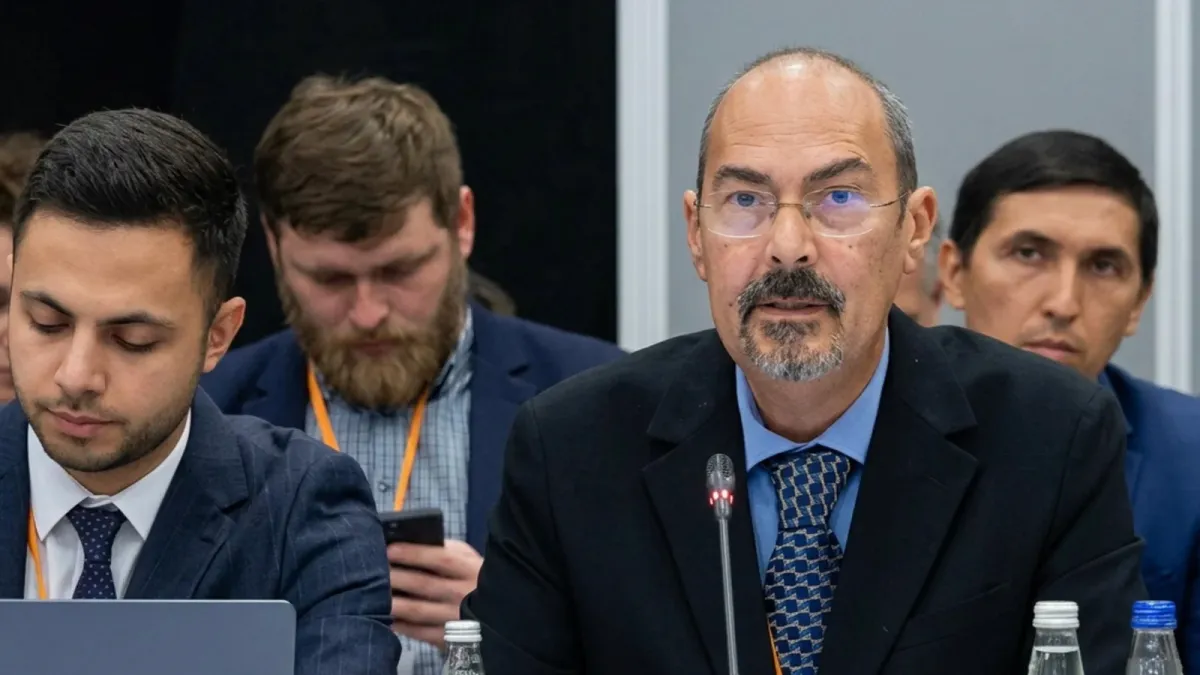
CAP-LC’s Thierry Valle at the OSCE-ODIHR meeting in Warsaw.
CAP-LC, an NGO accredited with the UN Economic and Social Council, filed its statement in Plenary Session 4, devoted to tolerance and non-discrimination. Its central allegation is that narratives originating in the Russian Federation reached authorities and media in Montenegro and Argentina, the two countries where Rudnev lived after completing his Russian sentence. In the NGO’s words, these narratives “triggered investigations and restrictive measures that would not have arisen without external influence.”
The original Russian proceedings already raise legal questions. Rudnev, the founder of a spiritual community that came to be known as Ashram Shambhala, was arrested in 2010 and convicted in 2013. Observers have pointed to the use of dubious witnesses, contested expert evidence, and accusations that changed during the case. Each of these features touches settled standards. Article 14 of the International Covenant on Civil and Political Rights (ICCPR) guarantees the right to examine prosecution witnesses and to be informed in detail of the nature of the charge. The European Court of Human Rights, whose jurisdiction Russia accepted at the time, has repeatedly held, from “Kostovski v. the Netherlands” (1989) to “Al-Khawaja and Tahery v. the United Kingdom” (2011), that a conviction resting decisively on untested witness statements requires strong counterbalancing safeguards.
The more novel legal issue arises after the sentence. Once a penalty has been served, the punitive relationship between State and individual should end. Circulating a contested conviction abroad, years later, prolongs that relationship by other means. CAP-LC describes a method that allows a State “to extend punitive control beyond its borders by disseminating misleading information,” and calls it transnational repression. Article 17 of the ICCPR prohibits unlawful attacks on a person’s honor and reputation, and Article 11 of the American Convention on Human Rights contains a parallel guarantee. Where the targeting stems from a person’s spiritual teaching, Article 18 of the ICCPR on freedom of religion or belief also applies.
Receiving States carry their own obligations. Montenegro and Argentina are both parties to the ICCPR. Montenegro is bound by the European Convention on Human Rights, and Argentina by the American Convention, which its Constitution has granted constitutional rank since the 1994 reform. The presumption of innocence applies in full to any new proceedings, and deprivation of liberty must rest on a reasonable suspicion grounded in facts. CAP-LC reports that the Argentine investigations produced no evidence of wrongdoing, yet led to detention and prolonged legal uncertainty. The matter remains before Argentine courts, and the country is not an OSCE participating state. The governing principles, however, are not in doubt.

Konstantin Rudnev in a poster promoting his teachings.
The OSCE framework remains relevant and a point of reference even for non-participating states. The 1990 Copenhagen Document commits participating States to the presumption of innocence and to fair proceedings, and the 1989 Vienna Concluding Document protects freedom of religion or belief. CAP-LC asked Russia to stop “targeting dissidents abroad through disinformation campaigns” and asked other States to approach Russian material on dissidents with great caution.
For lawyers, “caution” can be given operational content. It means independent verification before foreign-sourced allegations ground any coercive measure, disclosure to the defense of where such material came from, and no evidentiary weight for anonymous or media-originated claims. It also means asking whether a foreign conviction met fair-trial standards before relying on it, much as extradition courts have done since the European Court of Human Rights decisions “Soering v. the United Kingdom” (1989) and “Othman (Abu Qatada) v. the United Kingdom” (2012). Russia’s record, including the 2017 ban of the Jehovah’s Witnesses as an “extremist” organization, supplies ample reason for such scrutiny when minority spiritual movements are involved. The Rudnev case asks whether domestic due process is robust enough to resist prejudice imported from abroad.
Published also on Bitter Winter


